

Build a Dashboard
This guide walks through creating a dashboard from scratch - adding panels, choosing visualization types, configuring queries, and arranging the layout.
Creating a new dashboard
Section titled “Creating a new dashboard”- Navigate to Dashboards in the left navigation
- Select Create → Dashboard
- You start with an empty canvas - add panels to populate it
Alternatively, when you’re in Discover and have a visualization you like, select Save → Save to dashboard → New dashboard to create a dashboard seeded with that visualization.
Adding panels
Section titled “Adding panels”From the dashboard editor
Section titled “From the dashboard editor”- Select Add in the dashboard toolbar
- Choose Create new to build a visualization from scratch, or Add existing to reuse a saved visualization
- For a new panel:
- Select your index pattern or data source
- Write your query (PPL or PromQL)
- Choose a visualization type
- Configure axes, legends, and formatting
- Select Save to add the panel to the dashboard
From Discover
Section titled “From Discover”- Build your query in Discover
- Select a visualization type from the chart panel
- Select Save → Save to dashboard
- Choose an existing dashboard or create a new one
- The visualization appears as a new panel on the dashboard
Visualization types
Section titled “Visualization types”Each panel supports one visualization type. Choose based on what the data needs to communicate:
| Visualization | Best for | Typical query pattern |
|---|---|---|
| Line chart | Trends over time, rate changes | timechart, rate() |
| Area chart | Volume over time, stacked comparisons | timechart with by clause |
| Bar chart | Categorical comparisons, distributions | stats count() by field |
| Horizontal bar | Ranked lists, top-N comparisons | stats ... | sort - |
| Data table | Detailed breakdowns, raw data | Any query with fields |
| Metric value | Single KPI, numeric summary | stats count(), single PromQL value |
| Gauge | Progress toward a threshold | Error budget remaining, CPU usage |
| Pie chart | Proportional breakdown | stats count() by category |
| Heat map | Density across two dimensions | bin with two grouping fields |
| Tag cloud | Term frequency | stats count() by keyword |
Choosing the right visualization
Section titled “Choosing the right visualization”Some rules of thumb:
- Time-series data → line or area chart
- Comparing categories → bar chart
- Single number that matters → metric or gauge
- Distribution shape → heat map or histogram (bar chart with
bin) - Proportions of a whole → pie chart (use sparingly - bar charts are usually clearer)
Configuring panels
Section titled “Configuring panels”Query configuration
Section titled “Query configuration”Each panel has a query editor where you write PPL or PromQL. The query determines what data the panel displays.
For logs and traces (PPL):
search earliest=-6h source = logs-otel-v1*| where severityNumber >= 17| timechart span=5m count() by `resource.attributes.service.name`For metrics (PromQL - adjust metric names to match your environment):
sum by (service_name) (rate(http_server_request_duration_seconds_count[5m]))To parameterize the panel by a dashboard variable, reference it with $name or ${name}:
source = logs-otel-v1*| where `resource.attributes.service.name` = $service| stats count() by span(time, 1m)sum by (service_name) (rate(http_server_request_duration_seconds_count{service_name=~"$service"}[5m]))See Dashboard variables for how to define and chain variables.
Axes and formatting
Section titled “Axes and formatting”- Set axis labels and units (requests/sec, milliseconds, bytes, percentage)
- Configure Y-axis scale (linear or logarithmic) - log scale is useful when values span orders of magnitude
- Set min/max bounds to keep charts consistent across panels
- Choose color schemes that distinguish series clearly
Legends
Section titled “Legends”- Position legends at the bottom, right, or hide them for single-series panels
- Use legend values (min, max, avg, current) to add context without hovering
- For dashboards with many panels, hiding legends saves space - use panel titles instead
Thresholds
Section titled “Thresholds”Add horizontal threshold lines to panels to mark important boundaries:
- Error rate SLO (e.g., red line at 1%)
- Latency target (e.g., yellow line at 500ms, red at 1s)
- Capacity limits (e.g., red line at 80% CPU)
Thresholds make it immediately obvious when a metric crosses a boundary - no mental math required.
Chart-specific options
Section titled “Chart-specific options”Each chart type exposes its own controls in the Settings panel on the right. To reshape the query result before it’s charted (filter rows, derive a field, group, sort, limit), see Visualization transformations.
Bucket
Section titled “Bucket”Bar, line, area, histogram, and heatmap visualizations group raw data points into bins via a Bucket section:
| Field | What it does |
|---|---|
| Type | Aggregation function applied to values in each bucket: Sum, Mean, Max, Min, Count, or None (raw values). |
| Interval (time bucketing) | Time width of each bucket (auto, 1s, 1m, 1h, 1d, etc.). Set this when the X-axis is a timestamp. |
| Bucket Size (numeric bucketing) | The width of each bucket on a numeric axis. Leave empty for auto. |
| Bucket Count (numeric bucketing) | The approximate number of buckets to produce instead of fixing the size. Default is 30. |
For categorical bar charts (one bar per category), only Type applies — there’s nothing to bucket along the X-axis.
Value calculation (single-value visualizations)
Section titled “Value calculation (single-value visualizations)”Metric, gauge, and bar gauge visualizations show one number per series, so they need a rule for which number to show. The Value section provides a calculation method:
| Method | Result |
|---|---|
| Last | The most recent value |
| Last * | The most recent numerical value (skips nulls) |
| First | The earliest value |
| First * | The earliest numerical value |
| Min | Minimum value |
| Max | Maximum value |
| Mean | Average value |
| Median | Middle value |
| Variance | Statistical variance |
| Count | Number of values |
| Distinct count | Number of unique values |
| Total | Sum of all values |
Pick the calculation that matches the question the panel answers — Last for current state, Mean for typical behavior, Max for worst-case.
Value mapping
Section titled “Value mapping”Value mapping rewrites raw values into human-readable text or color-coded states. For example, map the numeric status codes 0, 1, 2 to OK, Warning, Critical with green, yellow, and red backgrounds. Configure mappings in the Value mapping section of metric, gauge, and stat visualizations.
Field unit and display
Section titled “Field unit and display”Set the unit (requests/sec, milliseconds, bytes, percentage) and decimal precision in the Standard options section. Units are display-only — they don’t change the underlying value.
Layout and arrangement
Section titled “Layout and arrangement”Grid layout
Section titled “Grid layout”Panels snap to a grid. Resize by dragging the bottom-right corner of a panel. Rearrange by dragging the panel header.
Layout tips:
- Put the most important panels at the top - that’s what people see first
- Group related panels together (e.g., all latency panels in one row, all error panels in another)
- Use full-width panels for time-series charts that benefit from horizontal space
- Use narrow panels for metric values and gauges - they don’t need much room
Sections
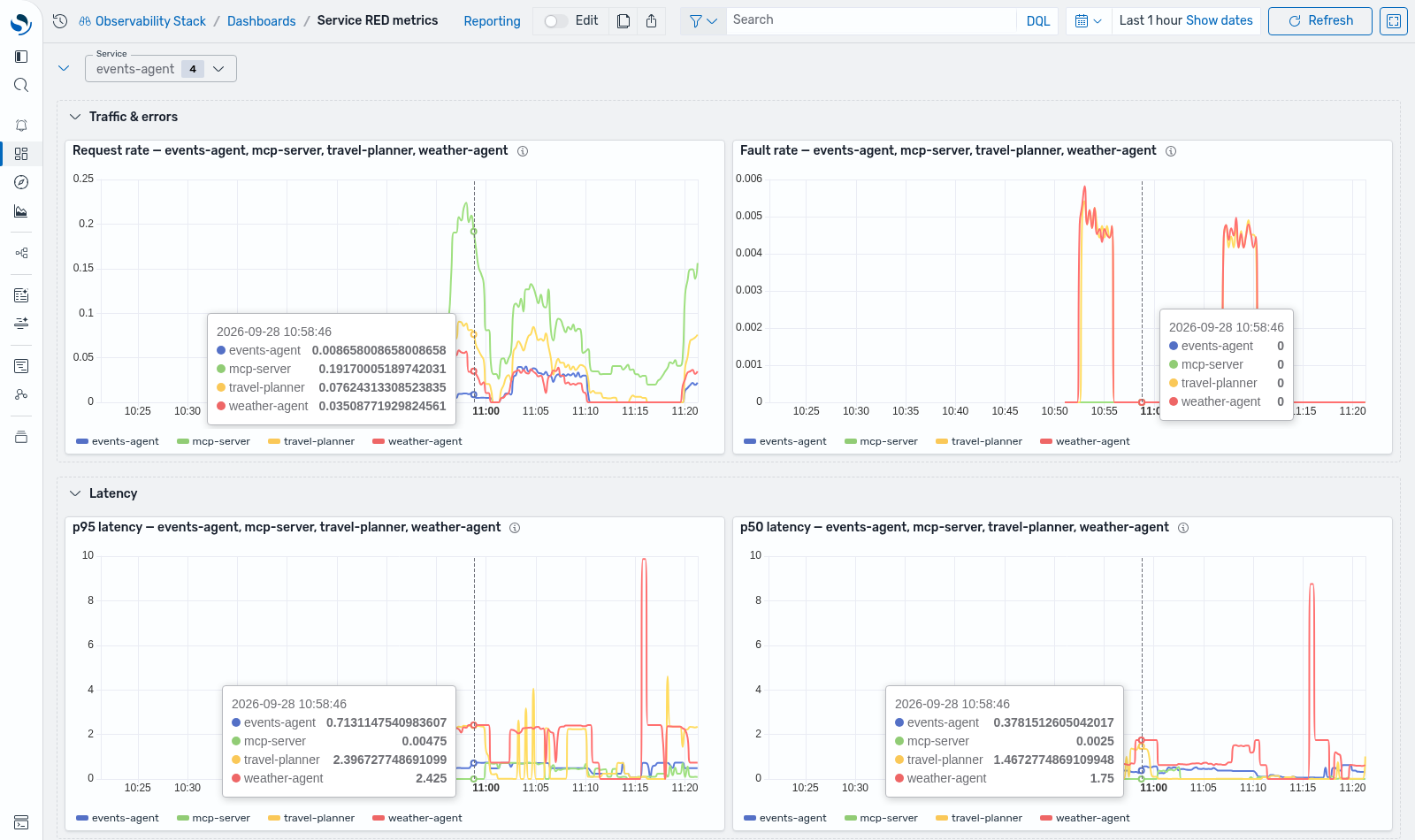
Section titled “Sections”Sections group panels under a named heading that you can collapse. Each section has its own grid, so you can keep related panels together (for example, Traffic & errors and Latency) and collapse the ones you don’t need right now.
Sections are turned off by default. To turn them on, add the following setting to opensearch_dashboards.yml and restart OpenSearch Dashboards:
dashboard.allowDashboardSections: trueTo work with sections, open the dashboard in Edit mode:
- Add a section: Select Add > Section.
- Add panels to a section: Use the section’s Add from library or Create new visualization options, or move an existing panel into the section.
- Reorder sections: Drag a section by its header.
- Rename or delete a section: Open the section options menu and select Rename or Delete. Deleting a section also deletes its panels.
- Ungroup all sections: Moves every panel back into a single grid.
Panels that don’t belong to any section appear in an Ungrouped group at the bottom of the dashboard.
Synchronized crosshair
Section titled “Synchronized crosshair”When you turn on the crosshair option, hovering over one time-series panel draws a crosshair at the same timestamp on every other time-series panel on the dashboard. Use it to line up a spike in one metric with changes in the others, such as request rate, errors, and latency.
To turn it on, open the dashboard in Edit mode, select Options, and turn on Sync crosshair across panels. The setting is saved with the dashboard and is off by default. It applies to line, area, and bar charts with a time-based x-axis that were built in Discover or the visualization editor. Legacy visualizations aren’t affected.
Recommended dashboard layouts
Section titled “Recommended dashboard layouts”Service health overview (4–6 panels):
| Row | Panels |
|---|---|
| Top | Request rate (line) · Error rate (line) · p95 latency (line) |
| Bottom | Error count by service (bar) · Top slow operations (table) |
Incident response (6–8 panels):
| Row | Panels |
|---|---|
| Top | Error rate (line) · Affected services count (metric) · Active traces with errors (metric) |
| Middle | Error logs by service (stacked bar) · Latency by service (line) |
| Bottom | Recent error logs (table) · Slow traces (table) |
Resource utilization (4–6 panels):
| Row | Panels |
|---|---|
| Top | CPU by service (line) · Memory by service (line) |
| Bottom | JVM heap usage (line) · GC time (line) · DB query latency (line) |
Time range controls
Section titled “Time range controls”The dashboard time picker in the top bar sets the time range for all panels simultaneously. This keeps everything aligned - when you’re investigating a 2am incident, every panel shows the same window.
Individual panels can override the dashboard time range if needed, but use this sparingly. Mismatched time ranges across panels create confusion.
Common time range patterns:
- Real-time monitoring: last 15 minutes or last 1 hour with auto-refresh
- Incident investigation: custom range around the incident window
- Trend analysis: last 24 hours or last 7 days
- Capacity planning: last 30 days
Auto-refresh
Section titled “Auto-refresh”Enable auto-refresh to keep dashboards current. Set the interval based on the use case:
- Operational dashboards: 10–30 seconds
- Trend dashboards: 5–15 minutes
- Capacity planning: manual refresh is fine
Building dashboards from Discover queries
Section titled “Building dashboards from Discover queries”The fastest way to build a dashboard is to start in Discover:
- Write a query in Discover that answers a specific question
- Choose the right visualization for the answer
- Save it to a dashboard
- Repeat for each question you want the dashboard to answer
This approach ensures every panel has a clear purpose - it answers a question you actually asked during investigation. Dashboards built this way tend to be more useful than ones designed abstractly.
Next steps
Section titled “Next steps”- Dashboard variables - parameterize panels with dropdowns
- Visualization transformations - reshape query results before they’re charted
- Sharing Dashboards - share, export, and best practices
- Discover Logs - build log queries to power dashboard panels
- Discover Metrics - build PromQL queries for metrics panels